Google Social search: followers and follows

This week Google rolled out a new feature to it’s SERPs and snippets when logged in. If you have a Google Profile and Google has indexed who you are connected to, there’s a chance that you will see a small profile picture along with a name and the text “shared this on <someplace>”.
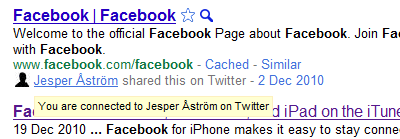
This is Google taking another step forward in integrating information it gathers about your social graph into it’s search results. This, of course, has a number of implications. You can read a bit more about the feature and what Google themselves have said about it in this Tech Crunch article.
Your connections
What isn’t apparent at first is who, exactly, are your friends. My initial presumption was that it was just the people I followed (on Twitter), but after a few searches it became apparent that it was both the people I follow and the people who follow me.

As you can see from the example above, the 4th and 5th placed search results are both indicated as being shared by people I’m connected to. I follow Alan Colville (Klout of 44), but Steve Cook (Klout of 23) follows me (I have Steve on a list, but I don’t directly follow him)..
Impact on SERPs
How much, if any, have those two tweets impacted upon the order of the results? Well, by logging out and doing a clean search for the same phrase the same two results are now 4th (still) and 9th. The second result has now dropped 4 places.
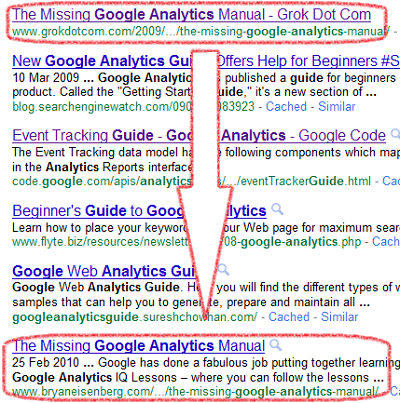
Ok, a number of additional factors could also be playing a role in moving that 9th placed result up to 5th – and as I didn’t do this test with the same Google account before this feature was launched I can’t say for sure how much of this movement is down to the shared link data. But I suspect it’s playing some part in it.
Importance of Twitter
What this does mean though, is that suddenly, following people on (public) social networks (in particular twitter) could lift the ranking of pages you’ve shared in those people’s search results. From an SEO perspective, the number of people you follow (and who follow you) became something to consider.
Shared links and little profile pictures makes Google’s use of this data really very obvious – but that’s limited to people logged into Google. What we can’t see as easily is how much Google is using this data in it’s regular organic search results, but we have seen from other case studies that it seems to already be a factor.